Fig Growing FAQ
Answers to the most common questions — from first tree to full harvest.
Getting Started
Chicago Hardy is the classic first fig for good reason — it is forgiving, cold-tolerant, and produces reliably even in its first or second year. Brown Turkey and Celeste are also excellent starting points: widely available, easy to find, and both produce well without much fuss. If you want to start with something a step above the mainstream, Ronde de Bordeaux is a compact, prolific early producer that punches well above its beginner-friendly price. Use the Variety Selector to find the best match for your zone and growing method.
A rooted cutting typically fruits in its first or second year — this is one of fig's great advantages over many other fruit trees. A tree planted from a larger nursery pot may fruit in its first season. Trees grown from seed take much longer (3–5 years) and are not recommended unless you enjoy the experiment — propagating from cuttings is faster, easier, and guarantees you get the exact variety you want.
Figs thrive in full sun — at least 8 hours per day. More sun means more sugar, better colour, and higher yields. In cold climates, a south- or west-facing position is ideal, especially against a wall that absorbs and reflects heat. Figs will grow in partial shade but fruit production and flavour both suffer significantly. For container growers, chase the sun — move your pot to wherever the light is best through the season.
The vast majority of cultivated figs are Common type — self-fertile and requires no pollination. This includes nearly every variety on this site. There are also San Pedro and Smyrna types that require a caprifig (a wild fig) for their main crop to ripen, but these are uncommon in home growing. Unless a variety is specifically labelled as Smyrna or San Pedro, assume it is self-fertile and you are good to go with a single tree.
Fig roots can be vigorous and surface-seeking, but they are not considered as invasive as willows or poplars. As a general rule, plant in-ground trees at least 8–10 feet (2.5–3 m) from foundations, walls, and drains. Roots follow water — if your drainage or irrigation runs toward a structure, roots may follow. Container growing eliminates root concerns entirely and is the preferred method anyway for cold-climate growers who need to overwinter their trees indoors.
Cold Climates & Chicago Growing
Yes — and this site exists as proof. The key is understanding your options: Chicago Hardy planted in-ground will die back to the roots in a hard winter and regrow each spring, often still producing a crop. Container growing gives you full control — you bring the tree indoors before hard frost and put it back out in spring, unlocking a far wider range of varieties that would not survive in-ground in Zone 5 or 6. Many of the best-flavoured varieties in this collection are container-grown precisely because of Chicago's winters.
There are two main approaches depending on your setup:
In-ground trees: After the first hard frost, tie the branches together, wrap the whole plant in burlap or frost fleece (3–4 layers), and mulch heavily around the base. The goal is to insulate, not heat — you are protecting the roots and lower stem. Unwrap in spring once night temperatures consistently stay above freezing.
Container trees: Move the container into an unheated but frost-free space — a garage, basement, or shed — before temperatures drop below −5°C (23°F). The tree will drop its leaves and go dormant. Water very lightly every 3–4 weeks just to stop the roots drying out completely. Bring back outside after last frost when new growth begins to appear.
It depends on the variety and how established the tree is. As a general guide:
- Wood and branches begin to suffer damage below about −10°C (14°F) for hardy varieties, and below −5°C (23°F) for less hardy ones.
- Roots are more cold-tolerant but can be killed if the ground freezes deeply around an unprotected container.
- Chicago Hardy is the most cold-tolerant common variety — the roots can survive to around −20°C (−4°F) and the tree will regrow from the base even if all the top growth dies.
Container trees are more vulnerable than in-ground trees because the roots are exposed to air temperatures rather than insulated by soil. Moving containers into a garage is the safest protection method in zones 5–6.
Both work, but they suit different goals:
In-ground is lower maintenance — no moving, no repotting — but limits you to the hardiest varieties (Chicago Hardy, Florea, Olympian) and the tree may die back each winter, sacrificing that year's breba crop.
Container takes more effort but opens up the entire range of flavours. You can grow Black Madeira, Violette de Bordeaux, Yellow Long Neck, and other premium varieties that would never survive a Chicago winter in the ground. The trade-off is annual repotting, regular watering, and moving the tree inside each autumn. For collector-grade flavour, containers are absolutely worth it. Keep in mind you would have to give these varieties a head start by waking them up earlier than what they naturally would do as they tend to take a bit longer to ripen the fruit.
Wait until nighttime temperatures are consistently above 4°C (40°F) — roughly after your last frost date. In Chicago that is typically mid-April to early May, though a warm south-facing patio can let you push this a week or two earlier if you can move trees back inside for any surprise frost. Putting trees out too early in cold wet conditions can shock them; putting them out too late loses valuable growing time. Watch the 10-day forecast rather than going purely by calendar date. For a more personalised recommendation based on your specific location and setup, use the Seasonal Planner on this site.
Varieties & Flavour
Sweetness is subjective but some varieties consistently top community rankings. Alma is often cited for its exceptional caramel-butter sweetness. Celeste delivers intense pure honey sweetness in a small package. Among berry-flavoured varieties, Angelito is widely considered top-tier — one of the sweetest berry figs known. For sheer intensity, Black Madeira and Figo Roxo produce a legendary rich sweetness in warm climates. Personally, my taste buds lean towards Black Madeira, Spadafora Dark, and Calderona in no particular order. Use the Variety Selector and filter by your preferred flavour profile to find your ideal match.
Fig trees can produce two harvests per year. The breba crop develops on last year's wood in late spring to early summer (May–June in most climates). The main crop develops on the current season's new growth and ripens in late summer to autumn (August–October). In cold climates, the breba crop is often lost when the previous year's wood dies back over winter — this is one reason container growing and careful overwintering matters so much. Some varieties (Desert King, Dalmatie) are particularly prized for their large, flavourful breba figs.
For in-ground planting in zones 5–6, the standouts are Chicago Hardy (the most cold-tolerant common variety), Florea (arguably the hardiest fig in the world, with very early ripening), and Olympian. For container growing in cold climates where you can overwinter indoors, the world opens up considerably — most varieties can be grown successfully with the right setup. The Variety Selector lets you enter your ZIP code and filter by growing method to see the best-scored varieties for your exact zone. To find your USDA hardiness zone, use the official USDA Plant Hardiness Zone Map.
The fig community broadly recognises five flavour profiles:
- Honey — pure, clean sweetness; golden or amber flesh; examples: Celeste, Alma, Peter's Honey
- Berry — strawberry, raspberry, or jammy fruit notes; dark flesh; examples: Violette de Bordeaux, Ronde de Bordeaux, Angelito
- Rich / Dark Berry — intense, wine-like complexity; examples: Black Madeira, Dark Portuguese, Ponte Tresa
- Mild / Classic — gentle sweetness, traditional fig taste; examples: Brown Turkey, Texas Everbearing
- Exotic — unusual complex notes — caramel, citrus, spice, tropical; examples: Zaffiro, LSU Tiger, Col de Dame Roja
Watering, Pruning & Feeding
Watering frequency depends on whether your tree is in-ground or in a container, and on the weather.
In-ground trees are largely self-sufficient once established (2–3 years). Water deeply once a week in dry spells, and more during fruit swell (July–August). Avoid overwatering — figs prefer dry feet and excess moisture near harvest can cause fruit to split.
Container trees dry out much faster and need much more attention. In summer heat, a large container may need watering every 1–2 days. Check by inserting your finger 2 inches into the soil — if it is dry, water thoroughly until it drains from the bottom. Never let a container tree sit in standing water.
The best time to prune is late winter or very early spring while the tree is still dormant — just before bud break. Pruning at this point minimises sap loss (fig sap can be a skin irritant) and lets you clearly see the branch structure.
For cold-climate growers, check which branches survived winter before pruning — dead wood will be dry, brittle, and dark inside when scratched. Remove dead wood first, then prune for shape. Aim for an open form that allows light and air into the centre. Avoid heavy pruning in summer as it can remove developing fruit and stress the tree mid-season.
This is one of the most common fig questions. The main causes are:
- Too much nitrogen — the tree is producing lots of lush green growth instead of fruiting. Cut back on feeding and switch to a lower-nitrogen fertilizer.
- Not enough sun — figs need at least 8 hours of direct sun to fruit well. A shaded tree will be green and healthy but unproductive.
- Too young — young trees often establish roots before fruiting. A tree in its first year may not fruit at all, which is normal.
- Wrong variety for your zone or season length — some late-ripening varieties simply cannot complete their cycle in cold climates. Use the Selector to check ripening timing against your zone.
- Stress — overwatering, underwatering, root disturbance, or repotting at the wrong time can all delay fruiting for a season.
Yellowing leaves have several common causes. Overwatering is the most frequent — check that your container drains freely and allow the top inch of soil to dry between waterings. Nutrient deficiency (especially nitrogen or magnesium) causes generalised yellowing; a balanced feed usually resolves this. Fig rust (Cerotelium fici) — a fungal disease — causes yellow-orange spots on the upper leaf surface and orange pustules underneath; this is best treated with a copper-based fungicide. Normal autumn senescence is also simply the tree going dormant — if leaves yellow and drop in late September or October with no other symptoms, that is natural. Use the Diagnosis Tool for a symptom-by-symptom assessment.
Container Growing
Start a rooted cutting in a small pot (1–3 gallons / 5–10 litres) and pot up as the tree grows — roughly doubling the container size each time the tree becomes root-bound. A mature productive container fig is typically in a 15–25 gallon (55–95 litre) container. Larger containers hold more moisture and nutrients but become very heavy to move. Fabric pots are popular for their air-pruning of roots and lighter weight. There is no need to rush to a large container — keeping trees slightly root-bound actually encourages fruiting over vegetative growth.
Figs need a well-draining mix — waterlogged roots are the number one killer of container figs. A popular community recipe is the 5-1-1 mix: 5 parts pine bark fines, 1 part perlite, 1 part potting compost. This drains fast, resists compaction, and supports healthy root development. Avoid heavy peat-based mixes that retain too much moisture. Adding about 10–20% coarse perlite or pumice to any standard potting mix significantly improves drainage and is a simple upgrade for most growers.
Yes — many growers keep figs in containers for 10+ years. The key is annual root pruning and repotting when the tree is dormant in late winter. You do not need to increase pot size every year — you can root-prune (remove 20–30% of the root mass from the sides and bottom) and put the tree back into the same container with fresh soil mix. This keeps the tree productive and a manageable size indefinitely. Container figs can be just as productive as in-ground trees with the right care.
Most fig varieties adapt well to containers. The naturally compact growers are particularly convenient: Petite Négra, Negronne, Fignomenal, and Violette de Bordeaux stay manageable sizes without aggressive pruning. For flavour-focused container growing, Angelito, Ronde de Bordeaux, I258, and Black Madeira are popular collector choices. Use the Variety Selector, set Method to Container, and the results will be filtered and scored for container suitability.
Propagation & Cuttings
Yes — and it is one of the easiest fruit trees to propagate. Figs root readily from hardwood cuttings taken during dormancy. This is how the entire fig enthusiast community grows and shares varieties — trading cuttings in winter is a major part of fig culture. A cutting taken correctly in January or February can be rooting by March and fruiting by its first autumn in the ground. No grafting, no rootstock, no specialist equipment required for basic propagation.
The ideal window is late winter while the tree is fully dormant — roughly January through early March in the Northern Hemisphere. At this point the wood is fully hardened, the cutting is full of stored energy, and the timing aligns well with starting the rooting process indoors before the growing season begins. Cuttings taken too early (before full dormancy in autumn) or too late (after bud break in spring) have lower success rates. Aim for pencil-thickness wood from the previous season's growth, cut to 6–8 inches (15–20 cm).
Under good conditions — warm temperatures (21–24°C / 70–75°F), appropriate rooting medium, and indirect light — most fig cuttings show roots within 3–6 weeks. Some varieties root faster than others; highly rated rooters like Chicago Hardy and Brunswick can show roots in 2–3 weeks. The rooting medium matters: a well-draining mix of perlite, vermiculite, or coarse sand retains enough moisture to support rooting without causing rot. Bottom heat (a seedling heat mat) significantly improves success rates and speeds up rooting.
Not strictly necessary — many growers achieve excellent results without it. However, rooting hormone (IBA — indole-3-butyric acid) in powder or gel form does improve success rates, especially for varieties that are slower to root, and is worth using. It is inexpensive and widely available at garden centres. Dip or dust the bottom inch of the cutting before inserting into the rooting medium. The bigger factors are temperature, moisture management, and not disturbing the cutting while it is rooting. The University of Florida IFAS Extension has a useful overview of fig propagation and culture if you want the science behind the method.
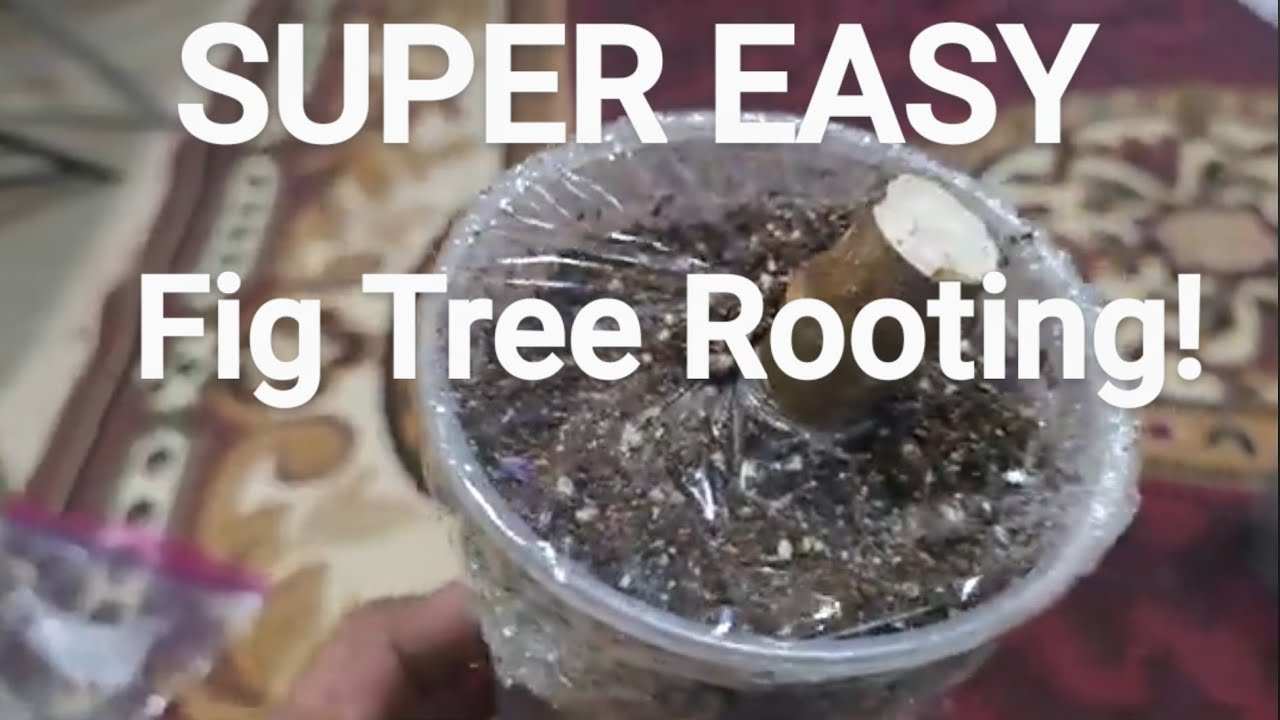
Here is the step-by-step method I use — the full walkthrough is in the video below.
- Medium: Promix or Sunshine Mix (interchangeable products). Optionally mix in 1 tablespoon of mycorrhizal fungi to support root development.
- Fertilizer: Add Schultz Bloom Plus 10-54-10 at ¼ strength mixed into your water first, then combine with the medium. The high phosphorus supports root initiation.
- Moisture level: The mix should be damp enough that you can squeeze a handful and it holds its shape — but no water should ooze out. Think wrung-out sponge.
- Cup: I use clear Dunkin’ cups — the transparency lets you watch for root development without disturbing the cutting. Poke drainage holes at the base.
- Filling: Fill the cup with your prepared mix and tap it gently on the table a few times to remove air pockets.
- Rooting hormone: Use Dip ‘n Grow, mixed according to the instructions. Dip the base of the cutting and insert it into the medium using a gentle spinning motion as you push it in.
- Cover & heat: Wrap the cup loosely with cling wrap to retain humidity and place it on a heating mat set to 78°F (26°C).
- Timeline: Expect to see roots pressing against the clear cup within 3 to 4 weeks.
Harvesting & Storing Figs
A ripe fig gives you several clear signals: the fruit droops or bends downward at the neck rather than pointing up; the skin softens noticeably to a gentle squeeze; the colour deepens fully (deep purple, near-black, golden yellow, or brown depending on variety); and the ostiole (the small opening at the base of the fig) may open slightly or show a drop of nectar. For varieties prone to splitting, harvest just before the skin cracks. The taste test is the final confirmation — a fully ripe fig should be intensely sweet with no trace of bitterness or starchiness.
No — figs do not ripen after picking. Unlike bananas or tomatoes, figs must ripen fully on the tree before harvesting. A fig picked underripe will stay exactly as is and never develop its full sweetness or texture. This is one reason fig flavour from home-grown trees is so much better than shop-bought fruit — commercial figs are picked early for transport and never reach their potential. Pick only when the fig shows all signs of full ripeness and enjoy it within a day or two for the best flavour.
Fresh figs are highly perishable. At room temperature they last 1–2 days at best; in the refrigerator in a single layer on a plate or tray, they can last 3–5 days. Do not wash figs until just before eating — moisture accelerates spoilage. For longer storage, figs freeze surprisingly well: freeze individually on a tray first, then transfer to bags. Frozen figs work beautifully in smoothies, baking, and jams even if the texture softens. Drying (in a dehydrator or low oven) produces excellent results and extends shelf life to months.
You can send them to me. I will gladly take them off your hands with a smile and even say thank you :)
A lot of the questions above end in the same place — where to get a variety without gambling on the label. I sell my own cuttings and rooted plants through FigStead, the marketplace I built and run, under the same name and the same growing notes you have been reading here.
My listings on FigStead →